Applications
Asset Management
The importance of regular monitoring
Although concrete armour layers are more resistant to wave action than armourstone layers, they also tend to degrade faster in the event of anomalies.
Therefore, regular preventive inspection of the structure is necessary. By regularly identifying and analyzing the condition of the revetment, managers can detect early signs of wear or damage, facilitating targeted interventions and minimizing repair costs.
Furthermore, asset management helps extend the lifespan of breakwaters, ensuring continuous protection against storm waves. This is especially important in the context of climate change, where rising sea levels and the intensification of extreme weather events pose increasing challenges.
Indeed, any major undetected anomaly in the armour layer can have significant economic consequences for the operator if port activities can no longer be maintained in a sheltered navigation area.


Initial Record
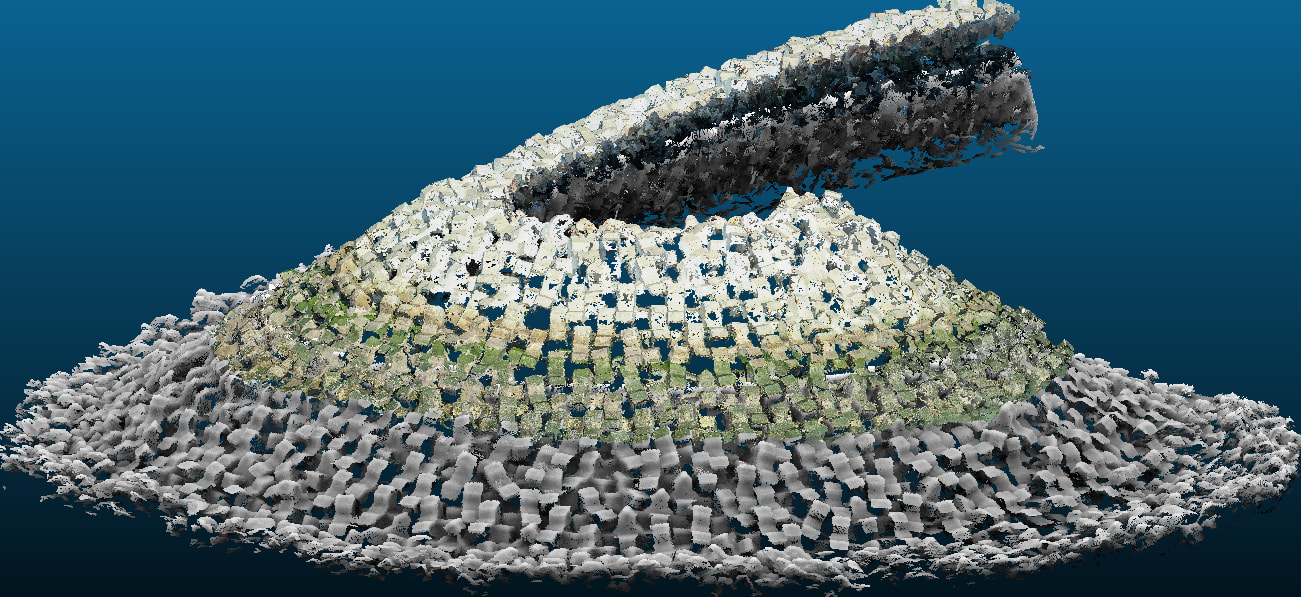
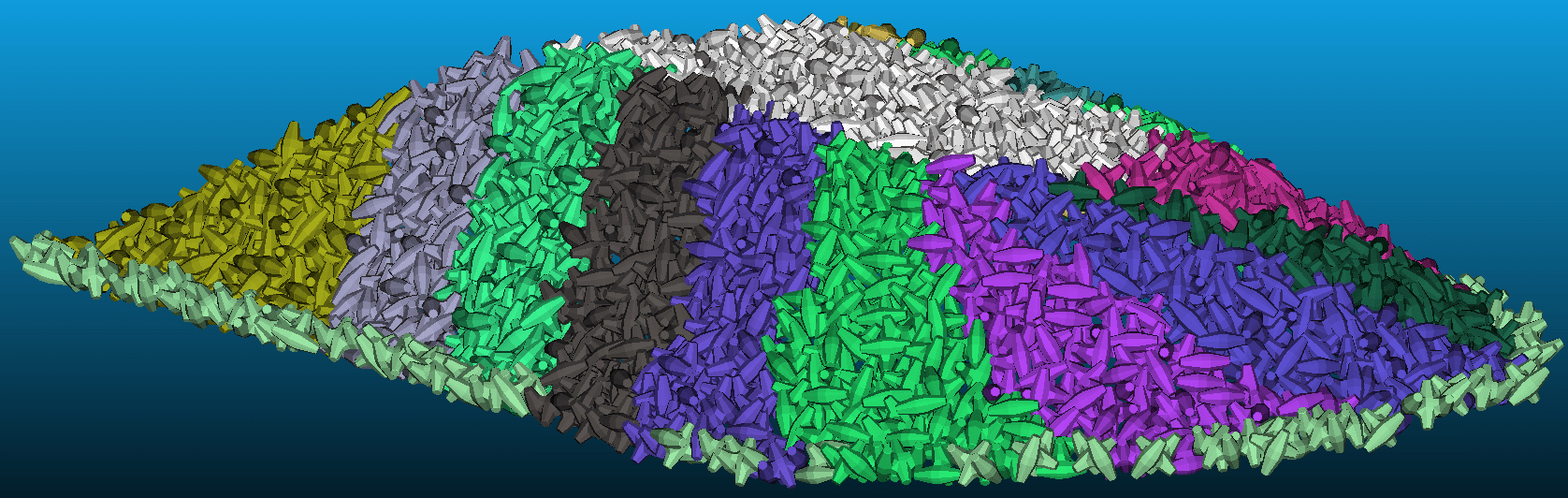
It is necessary to create an initial 3D model of the structure, ideally at the end of construction.
The scanning of breakwaters can be carried out by the port hydrographic service or by a qualified local provider. In this case, we can conduct an audit of the provider's capabilities and provide recommendations for the survey. Data acquisition can alternatively be performed by our specialized teams using our dedicated equipment, which can be mobilized on most opportunity vessels worldwide.
The initial 3D model helps identify broken armour units by comparing the 3D model as theoretically built and the point cloud derived from the survey.
It is also possible to precisely quantify in the virtual representation of the armour layer the quality of block interlocking. Automated quality control filters notably allow assessing the risk of extracting a block from the revetment.


Comparison of successive models
Once the digital twin of the breakwater is built, it is possible to update the 3D model at certain intervals. These intervals typically occur every 3 to 5 years or at significant moments for the structure, such as at the end of the contractor liability period or following an extreme wave event.
The generated 3D model allows for precise quantification of the movement of each block between the initial survey date and the date of the last survey. Indeed, the trajectory of each block is represented by a vector defined by a direction and an amplitude of displacement. It is thus possible to identify specific movements of the structure such as settling, large sliding, rocking, or block extraction with rearrangement.
The detailed analysis of the 3D model by a specialist coastal engineer is conducted by the asset owner technical department or an external consultant. We can also offer this complementary service through our specialized partner engineering firms.

Our associated services

Download
the white paper

Ensuring the asset management of your Breakwater.
A free guide to learn all about rubble-mound breakwater concrete armour layer asset management thanks to numerical 3D twin.
With SEABIM®, take control of your breakwater.