Blog
Which Real-Time Block Placement Monitoring Solutions Exist for Breakwaters?
Monitoring block placement on a breakwater represents a significant technical and economic challenge. An incorrectly positioned block can compromise the structure's resistance to wave action. Correcting this issue after initial placement can prove very costly. There are a number of solutions currently available for the real-time monitoring and verification of underwater placement.
You will find below a summary of the main approaches.
Why is placement monitoring so important?
Single-layer concrete armour breakwaters (Accropode™, Xbloc®, Core-Loc™, etc.) are designed to follow precise interlocking rules, including density, block contact, orientation and out-of-profile position. These rules are difficult to verify with the naked eye, especially underwater. Furthermore, the later a non-conformity is detected, the more complicated the rework will be, particularly if the faulty block is already overtopped by several placed rows.
The main solutions available
1. Diver guidance
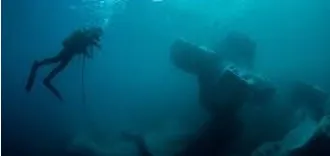
This is the most historically widespread placement assistance method. The diver is connected to the surface via an umbilical for breathing and audio communication, and visually guides the crane operator underwater. This solution is straightforward, requiring no advanced electronic or software technology. Placement is carried out effectively underwater when the diver is well trained in block placement and therefore aware of the placement rules.
It should be noted that the success of this method is contingent on underwater visibility; in conditions where visibility is poor or non-existent, the diver is unable to provide visual assistance to the operator. Furthermore, the presence of a person near the load during placement poses a significant safety risk. This is why some international maritime works companies no longer use divers on their block placement projects.
2. POSIBLOC or equivalent (TMC)
POSIBLOC is a guidance system based on an inertial sensor fitted directly to the block. This sensor transmits the block's position and orientation in real time to the operator via a 3D visualisation interface. The principle is straightforward: the sensor records the block's movements throughout the descent and placement phase, allowing the crane operator to adjust its position accordingly.
Its main appeal is its low CAPEX: it is one of the least expensive solutions in terms of initial investment among those available on the market. However, OPEX can quickly rise over time. The sensor is sensitive to impacts, and connection cable breakages can easily occur — this is unavoidable on a block placement site — generating replacement costs that are not always anticipated. Furthermore, the system's accuracy is subject to deterioration over time due to the inertial sensor's drift. Monitoring ceases immediately upon removal of the sensor post-placement, resulting in any subsequent movement or settlement going unnoticed.
3. The Echoscope (volumetric sonar)
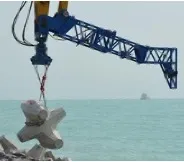
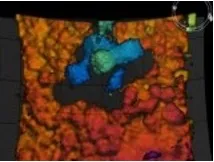
The Echoscope is a volumetric sonar developed by Coda Octopus that generates a real-time 3D point cloud of the placement area, regardless of underwater visibility. In contrast to solutions that rely on a sensor attached to the block, this approach provides a comprehensive view of the block and its surroundings (underlayer, neighbouring blocks) during the placement process. An above-water point cloud generation solution is also available.
This solution is better suited to large projects with substantial budgets, as the sensor's investment cost is high. Real-time 3D point cloud visualisation facilitates effective understanding of the underwater situation and ensures accurate representation of the block's position underwater. However, the accuracy of the real-time point cloud is lower than that of a multibeam sonar, which complicates the analysis of placement criteria, such as contacts between blocks.
4. Real-time 3D monitoring — SEABIM (multi-sensor)
The solution developed by SEABIM uses 3D as useful data, derived from an indirect point cloud measurement combining an above-water LiDAR with an underwater scanning sonar. The software continuously detects and tracks the block's 3D position and orientation within the point cloud, then calculates the interlocking filters every second. 3D monitoring is maintained post-unhooking, enabling the detection of any post-placement movement or settlement.
CAPEX is higher than for an inertial system, as investment in a scanning sonar and a LiDAR is required. Please note that the scope of OPEX is confined to the software licence cost and standard sensor maintenance. The final modelling accuracy achieved is satisfactory, as it is based on a point cloud from a multibeam sonar. However, the refresh rate and point density of the underwater point cloud are lower than those of a real-time volumetric sonar.
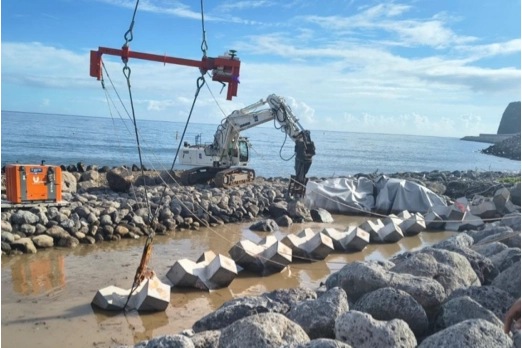
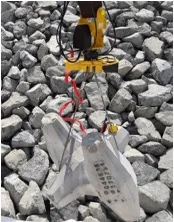
Block positioning and detection system installed on the lifting crane's spreader beam during Xbloc® placement on the M24 NRL project in Réunion – RAZEL-BEC
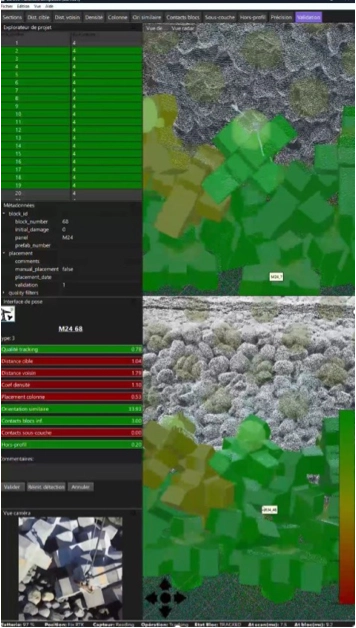
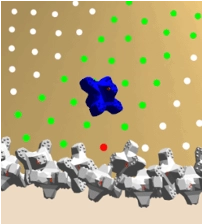
View of the SEABIM Placement Companion placement assistance interface
Comparison table of solutions
| Solution | ✅ Advantages | ❌ Disadvantages |
|---|---|---|
| Diver guidance | Simple, no heavy equipment investment | Dependent on visibility, safety risk |
| POSIBLOC | Low CAPEX, real-time 3D visualisation | Higher OPEX, sensor drift, risk of breakage, no post-placement monitoring |
| Echoscope | Real-time 3D sonar, independent of visibility | High CAPEX, point cloud visualisation takes priority |
| SEABIM multi-sensor | High accuracy, post-unhooking monitoring, real-time 3D visualisation | Higher CAPEX than inertial system; lower refresh rate and point density than a volumetric sonar |
In conclusion
There is no single solution that will work in every case. The choice depends on the size of the project, contractual requirements, on-site visibility conditions, and available budget. Each approach has its own strengths and limitations, so it is important to treat placement monitoring as a fully-fledged management tool, rather than a simple end-of-project inspection step.
Should you require further information regarding block placement assistance solutions, we would advise you to consult the resources offered by XBloc and Concrete Layer, which can guide you according to your project's specific needs.
More articles
July 2026
From Post-Processing to Real Time: Our New Step for Breakwater Placement Control
Since 2019, SEABIM has been digitising breakwater armour units in 3D through post-processing. Discover how real-time digitisation is now transforming placement control on maritime construction sites.
May 2026
How did CLI change their process for validating breakwater armor units using a 3D digital twin?
For years, validating the compliance of breakwater armor layers demanded the full-time presence of an on-site diver inspector. CLI (Concrete Layer Innovations) revolutionized this process by adopting a 3D digital twin approach — cutting costs and redefining inspection standards.
April 2026
How can 3D digital twins improve monitoring of breakwaters?
Breakwaters protect ports and coastal areas from swells and flooding, but monitoring them remains a major technical challenge. With climate change and more frequent extreme weather events, monitoring breakwaters has become critical. New solutions are emerging, notably 3D digital twins.